Crazy Eights
- 4.7
- Rating
- 1.00M
- Installs
- Free
- Price
 Analysis by App-foxy
I have always liked card games that are easy to explain but difficult to play perfectly, and Crazy Eights fits that description better than many larger mobile titles. This version from MobilityWare turns the familiar shedding game into a quick option for a spare moment, whether I am waiting for an appointment or looking for something light before bed. It is a free card game for Everyone, and the basic idea is immediately understandable: play a matching card, use an eight to change the suit, and try to empty your hand before the other players do.
That simplicity is the main attraction, but it is also where the game asks for a little patience. A round can feel relaxed when the cards cooperate, then suddenly become tense when an opponent changes the suit I need or leaves me with an awkward hand. After spending time with it, I found that the best experience comes from treating each round as a short decision-making exercise rather than tapping through cards as quickly as possible. The game rewards repeatable habits more than frantic play.
How the basic workflow feels in everyday play
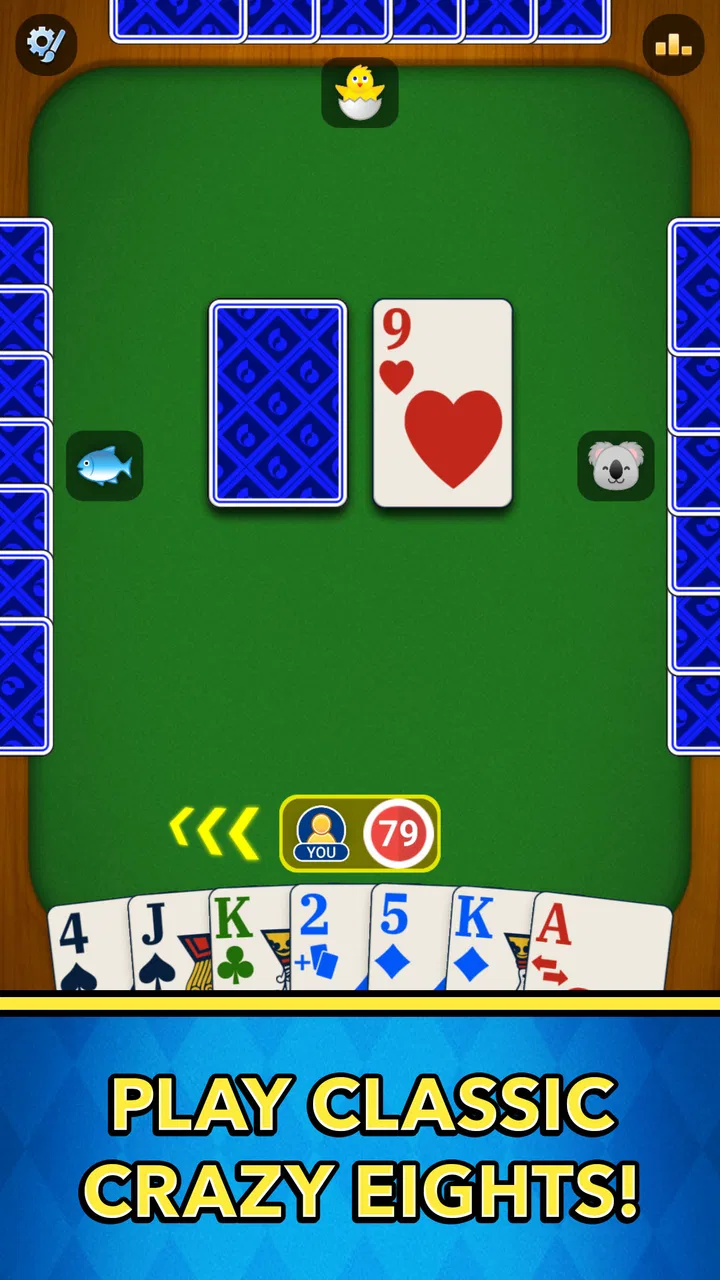
Starting a round is pleasantly direct. I can get into the action without learning a complicated progression system or studying a long tutorial. The table, the discard pile, the current suit, and my available cards are all the information I need, so the interface stays focused on the actual game. That makes it suitable for short sessions, especially when I do not want a strategy game that requires a large time commitment.
You May Also Like

 Blood Strike: 2.5 Anniversary
Blood Strike’s Loadouts Turn Every Drop Into a Tactical Gamble
A close look at Blood Strike’s custom loadouts: how fast access to signature weapons reshapes its battle royale rhythm, rewards preparation, and narrows the gap between fights.

 Pandora - Music & Podcasts
Pandora’s Music Is Easy to Start, but Harder to Recover
Pandora’s strength is its low-effort path from a seed to a station. Its weak spot is how much confidence it asks you to place in connection, setup, and quiet recovery.

 8 Ball Pool
 Is Built on Rivalries, Rematches, and Routine
A close look at the rivalries, rematches, shared routines, and unanswered safety questions that turn a quick pool match into a persistent mobile community.

 Samsung Music
’s Quiet Strength Is Playing What You Already Own
Its reach comes less from spectacle than from dependable access to a personal library. That simplicity is both the app’s strongest retention engine and its ceiling.

 AccuWeather: Weather Radar
AccuWeather Review: A Quick, Clear Forecast for Everyday Decisions
For everyday plans, the best forecast is the one you can understand quickly. AccuWeather makes rain timing, radar, and local conditions easy to act on, with a few trade-offs.

 Hill Climb Racing
Why Hill Climb Racing Still Turns Crashes Into One More Run
A tiny car, a bumpy hill and one more upgrade: Hill Climb Racing keeps resurfacing because its simple chaos makes every near-miss feel personal.
More From Our News Desk



The familiar rules give the game a useful advantage over more elaborate card battlers. I do not have to remember character abilities, deck-building restrictions, or a collection of special effects. My attention stays on the cards in front of me and on predicting what the other players may hold. The eight is the important tactical card because it lets me choose the next suit, but using it immediately is not always the smartest move.
My usual opening habit is to look at the shape of my hand before playing the first legal card. If I have several cards in one suit, I generally try to preserve that suit as a future route out of trouble. If my hand is spread across several suits, I pay more attention to which ordinary card can reduce that spread. This is a small adjustment, but it prevents me from making the common mistake of choosing a move only because it is available.
The game works particularly well in a realistic everyday scenario: I might have five minutes while a kettle boils or while waiting for a friend to arrive. One round gives me a complete activity rather than an unfinished campaign to remember later. When I have more time, I can continue playing, but the short-round structure means I do not feel punished for closing the app after a single game.
That convenience is supported by its modest device requirements. The release arrived on November 14, 2023, and the current version is 1.8.6.882, with support beginning at Android 8.0. Those details matter if I am installing it on an older phone rather than a recent flagship. I would still check how it behaves on a particular device, but the stated operating-system requirement makes it accessible to a broad range of Android users.
What I watch before committing a card
I try not to treat every legal move as equally good. Before tapping, I check whether playing a card will leave me with a suit I can continue using. I also look at the discard pile and ask whether my move gives the next player an obvious response. In a fast game, this takes only a second, but it changes the feel from random card disposal to controlled hand management.
One useful routine is to identify the card that would be most uncomfortable to keep until the end. It may be an isolated suit, a card that depends on a narrow response, or simply the card that makes the rest of the hand difficult to connect. Removing that problem early can be better than saving a more attractive card. This is especially helpful for new players who tend to protect their favorite cards and then discover that the remaining hand cannot be played smoothly.
I also avoid spending an eight just because I can. When the current suit is useful, keeping the eight gives me a way to escape if the table moves toward a suit I do not have. When my hand contains several cards of one suit, changing away from that suit may create more work for me than for the opponent. The best choice depends on the cards I expect to play next, not simply on the immediate relief of changing the color.
Settings and habits worth checking before playing seriously
Before settling into repeated rounds, I take a moment to look through the available settings and presentation options. I do not assume that the default arrangement is ideal for every player. On a small screen, a comfortable card layout and clear visual feedback are more important than decorative details, because a missed suit or a rushed tap can affect a round that was otherwise going well.
I also check how the game handles sound and other attention-grabbing feedback. For a quick game in public, at work, or beside someone who is sleeping, reducing unnecessary audio is practical. For a focused session, clearer feedback can help me notice when the turn changes or when an important card has been played. These are not strategic features, but they make the difference between a calm session and one filled with accidental taps.
My most useful setting-related habit is to establish the same playing environment each time. I keep the display comfortable, avoid playing while distracted by another notification, and make sure I can see the active suit before choosing a card. Because the rules are simple, interface friction becomes disproportionately noticeable. A few seconds spent making the table readable can improve decisions more than trying to invent an elaborate strategy.
There is also a practical reason to review purchase prompts before playing regularly. The game is free to download, while optional in-app items range from $3.99 to $29.99 per item. I would approach those purchases as convenience spending rather than something required to understand the card game. Anyone who wants a purely no-cost experience should be comfortable dismissing optional offers and playing within the free portion instead of assuming every prompt is part of the core rules.
Faster patterns that improve decision-making
Once the basic workflow feels natural, I begin using a few repeatable patterns. The first is suit concentration. If I can reduce the number of suits in my hand, I create more chances to play consecutively. This does not mean I always keep the largest group, because the table may make that suit dangerous, but it gives me a simple default plan when the position is unclear.
The second pattern is to track what the discard pile suggests without trying to memorize every card. I pay attention to suits that have appeared repeatedly and to the suit chosen after an eight. If a player repeatedly avoids a certain suit, I treat that as a clue rather than proof that the suit is absent from their hand. This light observation is more realistic than attempting perfect card counting during a casual mobile round.
A third habit is to plan backward from the final card. If I have a possible last card, I ask what must happen immediately before it becomes playable. That question often reveals that I should preserve a matching card or avoid changing the suit too early. It also helps me notice when a hand looks nearly finished but is actually blocked by one awkward card.
Experienced players can combine these habits with a simple turn checklist:
- Identify the suit that gives the hand the most follow-up options.
- Notice whether the next player appears to benefit from the current suit.
- Decide whether an eight is an escape card, a setup card, or merely a convenient play.
- Keep a possible finishing sequence in mind instead of focusing only on the current discard.
This checklist is intentionally short. If I spend too long analyzing a casual round, the game loses its relaxed quality. The point is not to turn every move into a calculation; it is to replace impulsive taps with a consistent glance at the whole hand.
Another useful adjustment is changing the goal depending on the hand. With a flexible hand, I play for control by preserving choices. With a poor hand, I play for damage limitation by removing isolated cards and saving the card that can reopen the game for me. That distinction matters because not every round is realistically winnable from the beginning. Good play sometimes means improving the next position rather than forcing an immediate comeback.
Where the game becomes less satisfying
The same accessibility that makes this a good casual title may disappoint players looking for a deep competitive card platform. The core loop remains centered on matching cards and managing eights, so there is no need to expect the variety of a collectible card game, a long campaign, or a complex multiplayer ladder. If I want evolving decks, unusual abilities, or a large strategic meta, I would choose a different category of card game.
There can also be moments when the result feels heavily shaped by the deal. Skill influences how well I manage a hand, but a player cannot always overcome a sequence of poor matches or an opponent receiving a smoother route. I see that as part of the identity of Crazy Eights rather than a flaw unique to this version, yet it is worth knowing before treating every loss as a strategic lesson.
The free-to-play structure is another point to consider. Optional purchases may be reasonable for someone who enjoys the game and wants to spend money on it, but players who dislike in-app offers may find the surrounding prompts more noticeable than they would like. I would not recommend installing it for someone who wants a completely purchase-free mobile environment unless they are comfortable ignoring optional items.
I would also skip it if my main requirement is a rich social experience with friends. The appeal here is the quick card-game loop, not a promise of a broad community or a detailed communication system. For a quiet solo break, that focus is a strength. For a group searching for a shared digital table with extensive social tools, another option may fit better.
How it compares with familiar alternatives
Compared with solitaire, this game gives me more direct tension because the other hands influence the suit and the pace. Solitaire is often better when I want a solitary puzzle with no pressure from opponents. Crazy Eights is the stronger choice when I want a short contest and enjoy reacting to changing conditions rather than solving a fixed layout.
Compared with collectible card games, it is much easier to start and much cheaper in terms of attention. I do not need to assemble a deck, learn a large card pool, or keep up with changing strategies. The trade-off is obvious: there is less long-term variety and less room for specialized construction. I would choose this game for accessible repetition, not for a hobby built around collecting and optimization.
Traditional physical cards still have advantages. Playing around a table with friends offers conversation and a sense of occasion that a phone cannot reproduce. The mobile version wins when I am alone, short on time, or without a deck nearby. It turns a familiar rule set into something available whenever I need a small distraction, but it cannot replace the social atmosphere of a real game night.
MobilityWare’s presentation makes the game approachable for people who already know the rules and for those returning to them after years away. Its average rating is 4.6 from around 16K ratings, and it has passed 500K installs, which suggests that the straightforward format has found a sizable audience. I see those figures as signs of broad appeal rather than proof that every player will enjoy the same pace or purchase model.
Who will get the most from it
I would recommend this version to someone who wants a familiar card game that starts quickly, works well in short sessions, and does not demand a large learning investment. It is also a reasonable choice for families looking for an Everyone-rated game with rules that can be explained in a few minutes. A new player can begin with basic matching, then gradually learn to preserve suits, manage eights, and think about the final card.
It suits people who enjoy small strategic decisions repeated over many rounds. The satisfaction is not in unlocking a huge system; it is in noticing that a better choice was available and applying that lesson in the next hand. I especially like it for those in-between moments when a full game would be too much but scrolling through a feed feels empty.
I would point more competitive players toward a title with deeper deck construction, stronger ranked systems, or more control over opponents. I would also steer away anyone who dislikes chance as a central part of card play. Even with careful decisions, the deal and the sequence of plays can shape the outcome. Finally, people who want a fully social table should consider a game designed around friends and communication rather than a compact solo-friendly experience.
My verdict after building a repeatable play style
Crazy Eights succeeds because it does not overcomplicate a game that is already enjoyable. I can open it, understand the situation, and play a meaningful round without preparing first. The best results come from a few practical habits: reduce suit clutter, protect flexibility, observe the discard pile, and treat the eight as a resource instead of an automatic move.
Its limits are just as clear. The card system is intentionally familiar, chance remains important, and optional purchases mean the free experience may not appeal to everyone. Players searching for a long campaign, deep collection mechanics, or a strong social layer should look elsewhere. Those are not reasons to dismiss it; they simply define what this game is trying to do.
For me, the strongest use case is a short, repeatable break where I want enough thought to stay engaged but not enough complexity to feel like homework. The Everyone rating, free entry point, and support for Android 8.0 or later make it easy to consider, while the current version gives the experience a clear point of reference for installation. If you want a dependable quick card game rather than a sprawling mobile hobby, this is an easy recommendation.
FAQs for Crazy Eights
01What is Crazy Eights, and how do you play it?
Crazy Eights is a classic card game available as a mobile app for both Android and iOS. The objective is to be the first to get rid of all your cards. Players take turns matching a card in their hand with the current card on the discard pile by number or suit. Eights are wild, allowing the player to change the suit, thereby adding a strategic twist to the game.
02Can I play Crazy Eights offline, or is an internet connection required?
Crazy Eights offers both offline and online modes. You can enjoy the game against AI opponents without an internet connection, which is great for playing on the go. If you prefer playing against real players, the online multiplayer mode requires an internet connection to connect you with friends or random players worldwide.
03Are there any in-app purchases in Crazy Eights?
Yes, Crazy Eights includes in-app purchases. While the app is free to download and play, you can buy additional features such as new card decks, themes, or ad-free experiences. These purchases are optional and designed to enhance your gaming experience, but they are not necessary to enjoy the core gameplay.
04Is Crazy Eights suitable for all ages?
Crazy Eights is suitable for all ages and offers a fun, family-friendly gaming experience. The rules are simple enough for kids to understand, yet the strategic elements keep it engaging for adults. It’s a great way to improve critical thinking and decision-making skills while enjoying a classic card game.
05What are the main features of the Crazy Eights app?
The Crazy Eights app features both single-player and multiplayer modes, customizable card decks, and various game themes. It also includes leaderboards and achievements to track your progress and compete with others. The user-friendly interface and vibrant graphics ensure an enjoyable gaming experience for all players.
Pros
- Simple rules make it easy to learn.
- Fast-paced gameplay keeps it engaging.
- Multiplayer mode for playing with friends.
- Customizable game settings for variety.
- Offline mode available for on-the-go fun.
Cons
- Limited card designs available.
- Occasional lag in multiplayer mode.
- Ads can interrupt gameplay flow.
- No tutorial for complete beginners.
- In-app purchases can be pricey.

Crazy Eights
Gallery